
If you have ever felt your heart race out of nowhere or felt trapped in a loop of anxious thoughts, you know how quickly panic takes over. The STOPP method is a Cognitive Behavioral Therapy (CBT) tool I use to cut through that noise. According to the National Institute of Mental Health (NIMH, 2023), nearly 31.1% of U.S. adults experience an anxiety disorder at some point in their lives. When distress spikes, your brain’s emotional security guard (the amygdala) completely overrides your logical center (the prefrontal cortex). STOPP acts like a physical circuit breaker, giving your brain the seconds it needs to regain control.
By moving step-by-step through Stop, Take a breath, Observe, Pull back, and Proceed, you learn how to stop reacting on auto-pilot. Clinical research from the American Psychological Association (APA, 2017) confirms that structured CBT tools like this significantly reduce panic recurrence and build real distress tolerance over time.
How to Use Step 1 (Stop) in the STOPP Method
The very first thing you need to do when emotion surges is simply pause. According to the Association for Behavioral and Cognitive Therapies (ABCT, 2021), panic attacks usually peak within 5 to 10 minutes. Catching that physical wave early is everything if you want to prevent a full spiral.
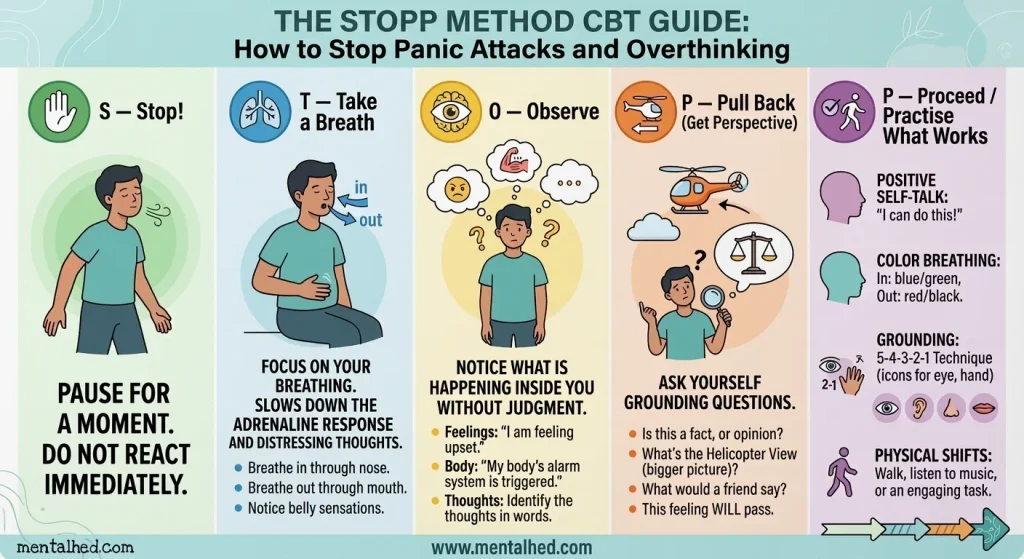
The moment you feel your chest tighten or your mind start to race, physically or mentally shout: “STOP!” Picture a massive red stop sign in your mind, or literally freeze your body in place for two seconds. This tiny pause breaks your brain’s automatic urge to run away, yell, or send a message you’ll regret, opening up a safe gap between whatever triggered you and how you choose to respond.
How to Practice Step 2 (Take a Breath) to Stimulate the Vagus Nerve
Once you pause, bring your focus entirely to your breathing. A landmark study published in Frontiers in Human Neuroscience (NCBI, 2018) showed that slow, diaphragmatic breathing quickly lowers cortisol levels and calms negative emotional physical feedback loops. Deep belly breathing directly stimulates your vagus nerve, signaling your nervous system to drop out of panic mode.
Inhale slowly through your nose for a count of four, letting your belly expand. Then, exhale slowly through your mouth for six seconds. Keeping your exhale longer than your inhale sends a direct chemical message to your brain that you are safe right now.
How to Practice Step 3 (Observe) for Cognitive Defusion
Next, step back and become a neutral observer of your own mind. In Acceptance and Commitment Therapy (ACT) literature highlighted by Psychology Today (2020), this is called cognitive defusion—the art of realizing that your thoughts are just temporary mental events, not absolute facts.
Notice what is happening inside you without trying to fight it or fix it right away:
- Bodily Sensations: “My hands are shaking and my chest feels heavy.”
- Emotions: “I’m feeling intense fear right now.”
- Thoughts: Shift “I can’t handle this” to “I am having the thought that I can’t handle this.”
Putting your experience into words creates instant breathing room between you and your anxiety.
How to Use Step 4 (Pull Back) to Get Perspective
Now it’s time to test your thoughts against reality (what therapists call the “Helicopter View”). Studies in the Journal of Consulting and Clinical Psychology (2019) show that misinterpreting uncomfortable body sensations is what keeps panic cycles spinning.
Ask yourself these four grounded questions:
- Fact vs. Opinion: Is this catastrophic thought a proven fact, or just my anxiety talking?
- The Compassion Test: What would I say to a friend going through this exact moment?
- Temporal Scope: Will this matter in a week, a month, or a year?
- Normalizing Self-Talk: Remind yourself: “This adrenaline feels awful, but it isn’t dangerous.”
Getting perspective pulls your prefrontal cortex back online so you can see the bigger picture.
How to Execute Step 5 (Proceed) Using 5-4-3-2-1 Grounding
Finally, pick a clear, constructive action. A review in NCBI / PubMed Central (2022) confirms that sensory grounding pulls your brain’s focus away from internal panic loops and anchors you firmly back in the room.
Walk yourself through the 5-4-3-2-1 Grounding Method:
- 5 Things You See: Spot five distinct objects around you.
- 4 Things You Touch: Feel four textures (your feet on the floor, your phone casing).
- 3 Things You Hear: Listen for three subtle background sounds.
- 2 Things You Smell: Notice two scents in the air.
- 1 Thing You Taste: Focus on one taste in your mouth.
Finish with a simple grounding phrase—“I am safe, and this will pass”—and step back into whatever you were doing.
What Is the Difference Between the STOP and STOPP Skills in CBT and DBT?
People often ask me if STOP and STOPP are the same thing. The DBT “STOP” skill is a 4-step tool (Stop, Take a step back, Observe, Proceed) built for rapid crisis survival when you need to avoid impulsive actions.
The CBT “STOPP” skill adds a vital fifth step: Pull Back / Put in Perspective. Clinical materials from the National Health Service (NHS, 2021) emphasize that this extra step focuses directly on cognitive restructuring—helping you reframe negative thoughts before taking your next step.
| Feature | DBT STOP Skill | CBT STOPP Skill |
|---|---|---|
| Number of Steps | 4 Steps | 5 Steps |
| Primary Clinical Goal | Distress tolerance & crisis survival | Cognitive restructuring & emotion regulation |
| Key Mechanism | Pause immediate behavior | Reframe thoughts & gain perspective |
Downloadable STOPP Resources & Worksheets
Having visual reminders ready before distress hits makes a massive difference. Guidelines from the Substance Abuse and Mental Health Services Administration (SAMHSA, 2023) show that having quick-reference self-help tools on hand increases how often people actually use their coping skills in real-life moments by up to 40%.
- STOPP Technique CBT Worksheets: Download our fillable reflections to work through past triggers and plan your next steps.
- Printable Wallet Cards: Grab a pocket-sized guide to keep the 5 steps on you wherever you go.
Frequently Asked Questions (FAQ)
How to stop panic attacks instantly using CBT?
While you can’t always turn panic off like a light switch, combining the STOPP method with long, slow exhales usually calms your physiological distress down within 2 to 5 minutes (Frontiers in Human Neuroscience, 2018).
How long does the STOPP process take during acute anxiety?
It’s completely flexible. You can run through a silent mental check in 30 to 60 seconds mid-conversation, or take 5 to 10 minutes writing out each phase on a worksheet when you have time to sit down.
Can the STOPP technique be used for anger management?
Absolutely. STOPP was originally designed to help with anger. The initial pause stops you from snapping, while the “Pull Back” step helps you decide if your reaction matches the situation (NHS, 2021).
