
The 5-4-3-2-1 sensory grounding method is a clinical somatic grounding technique designed to interrupt acute anxiety, dissociation, and panic attacks by re-anchoring your attention in the physical present. When emotional distress triggers your sympathetic nervous system, your brain enters a fight-or-flight loop that misinterprets internal fear as an active external threat (NIMH 2023). By systematically engaging all five senses, this process forces the prefrontal cortex to process external environment data, reducing autonomic arousal (APA 2020).
What Is the 5-4-3-2-1 Grounding Method?
The 5-4-3-2-1 grounding method is a somatic awareness exercise that uses your physical environment to interrupt emotional escalation and sensory overwhelm. Originating from Cognitive Behavioral Therapy (CBT) and Dialectical Behavior Therapy (DBT), this intervention systematically directs cognitive focus toward tangible sensory stimuli in descending numerical order (ABCT 2021). When panic or trauma triggers occur, the brain’s amygdala suppresses rational thought, causing intense hyperarousal or bodily dissociation (NCBI 2019).
By identifying 5 visual items, 4 tactile sensations, 3 auditory signals, 2 olfactory inputs, and 1 taste, you force your brain to switch from internal cognitive loops to external environmental processing. Research shows that structured sensory exercises stimulate the vagus nerve, initiating a parasympathetic nervous system response that lowers elevated heart rates and regulates rapid breathing patterns within 2 to 5 minutes (SAMHSA 2022). This technique works as a standalone tool during sudden panic spikes or as the execution phase within broader cognitive protocols like the STOPP method.
How to Use the 5-4-3-2-1 Technique Step-by-Step
To perform the 5-4-3-2-1 technique, pause your current activity and complete the following five sensory checks slowly while taking deep, controlled exhales:
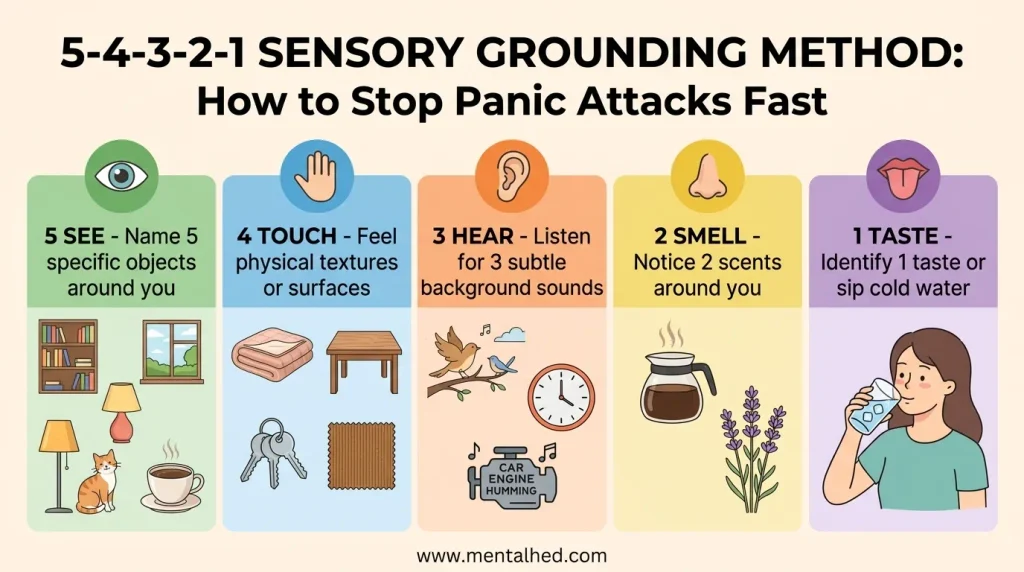
- 5 Things You Can See: Look around your immediate surroundings and name 5 distinct objects out loud or mentally. Focus on specific physical details, such as the pattern of a wall texture, a reflection on glass, or the color of a pen (e.g., “I see a blue coffee mug, a wooden desk seam, a green leaf, a desk lamp switch, and a silver paperclip”).
- 4 Things You Can Touch: Pay direct attention to 4 physical textures or contact points. Feel your feet resting flat on the floor, the texture of your shirt sleeves, the cool metal edge of a desk, or the weight of a phone in your hand.
- 3 Things You Can Hear: Shift your awareness outward and identify 3 subtle background sounds. Listen for the hum of an air conditioner, distant traffic, birds outside, or your own steady breathing.
- 2 Things You Can Smell: Notice 2 distinct scents around you. If ambient smells are faint, lean toward your clothing, smell a cup of coffee, or inhale the scent of hand lotion or a nearby wooden surface.
- 1 Thing You Can Taste: Identify 1 taste inside your mouth. Notice the lingering flavor of mint, toothpaste, coffee, or simply take a deliberate sip of cold water and track the sensation down your throat.
Why Sensory Grounding Stops Panic Attacks
Sensory grounding halts panic attacks by interrupting amygdala-driven threat loops through forced attentional shifting to physical stimuli. During acute panic, the central nervous system experiences autonomic dysregulation, flooding the bloodstream with adrenaline and cortisol (NIMH 2023). This physiological response tricks the brain into assuming immediate danger, perpetuating catastrophic thinking patterns like “I am losing control” or “I cannot breathe” (APA 2017).
Executing a structured sensory task consumes working memory capacity, leaving fewer cognitive resources available to sustain panic-inducing thoughts (NCBI 2021). Furthermore, taking deep abdominal breaths during sensory checks activates vagal nerve pathways, suppressing sympathetic fight-or-flight signaling and lowering baseline blood pressure (SAMHSA 2023). This combination of somatic regulation and cognitive redirection allows your nervous system to recognize that your current environment is physically safe.
5-4-3-2-1 Method vs. Box Breathing: Which Is Better?
The 5-4-3-2-1 method relies on external environment tracking, whereas box breathing focuses exclusively on internal somatic rhythm control. Choosing between them depends on whether your anxiety manifests as mental overthinking and dissociation or physical hyperventilation and elevated heart rate (ABCT 2022).
| Feature | 5-4-3-2-1 Grounding Method | Box Breathing (4-4-4-4) |
|---|---|---|
| Primary Mechanism | External sensory tracking & cognitive redirection | Autonomic nervous system regulation via breath holding |
| Best For | Dissociation, overthinking, derealization, panic spirals | Physical hyperarousal, rapid heart rate, acute stress spikes |
| Execution Focus | 5 physical senses (See, Touch, Hear, Smell, Taste) | 4-second inhale, 4-second hold, 4-second exhale, 4-second hold |
| Integration | Ideal for Step 5 (Proceed) of the CBT STOPP method | Ideal for Step 2 (Take a Breath) of the CBT STOPP method |
Downloadable 5-4-3-2-1 Grounding Worksheet
Practicing somatic techniques when calm prepares your nervous system to execute them automatically during acute panic spikes. Download our printable A4 5-4-3-2-1 practice log to keep in your pocket, desk, or self-help binder for step-by-step guidance whenever anxiety strikes.
Frequently Asked Questions
How fast does the 5-4-3-2-1 method work?
The 5-4-3-2-1 method typically reduces panic symptoms and emotional distress within 2 to 5 minutes by redirecting cognitive focus and slowing physiological arousal.
What if I cannot smell or taste anything in my environment?
If ambient smells or tastes are absent, improvise by imagining your favorite scent (e.g., lavender or rain) or focus on the physical temperature inside your mouth; the key is shifting your attention to the sensory category, not finding an intense stimulus.
Can I use 5-4-3-2-1 grounding with the STOPP method?
Yes, the 5-4-3-2-1 grounding technique serves as the ideal sensory action tool during Step 5 (Proceed) of the 5-step CBT STOPP protocol to transition back into daily activities after pausing panic spirals.
